
Mountain Lion
Mountain lions are easily distinguished from Arizona’s other wild cats—the bobcat, ocelot and jaguar. Bobcats and ocelots are much smaller than mountain lions. Bobcats have a short, “bobbed” tail and pointed ears with tufts, while ocelots have heavily spotted pelts and long, ringed tails. Jaguars are larger and heavily spotted with rosette patterns.

About
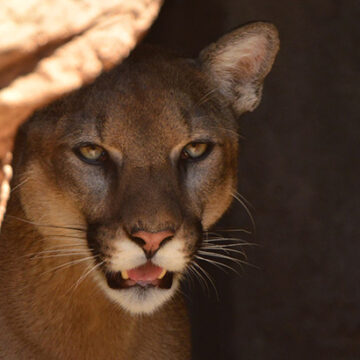
Adult mountain lions are tan to light cinnamon in color with a white underbelly and have black on the back of their ears and the tip of their tail. Kittens are heavily spotted. Mountain lions have very long tails which can be more than a third of the total length of the animal. Males and females vary in size and weight, with males being about 1/3 larger than females.
Mountain lions are stalk and ambush predators that hunt primarily at night and rely on ambush to kill their prey. Uneaten portions of a kill are cached (hidden or covered with leaves, dirt, or other debris). Typically, they prey on deer, but will consume other large mammals as well, such as bighorn sheep, elk and pronghorn. They also feed on smaller animals when necessary, such as javelina, turkey, coyotes, bobcats, skunks, rodents, and even insects. In Arizona, mountain lions are known to kill and consume domestic livestock which often creates conflicts with livestock operators.
Although documented in and around communities adjacent to wild lands, mountain lions tend to avoid human dominated-landscapes and interactions with humans, which results in relatively few reported mountain lion sightings. While mountain lions typically pose little threat to humans, conflicts can occur when people recreate in mountain lion habitat or when a mountain lion frequently uses human dominated-landscapes. AZGFD is committed to helping people learn how to behave responsibly and coexist safely in mountain lion habitat.
Life History
Mountain lions may breed at any time of the year, with kittens born in any month; however, in North America, the majority of births occur from May through October. Females typically first breed around 2½ to 3 years of age, while males first breed around their second year. Litter sizes of 2-4 are common, and females may raise kittens in consecutive years, though about 1½ years between litters is more common. Young remain with the mother for about 11-18 months, learning the skills necessary to survive independently. Juvenile males tend to disperse much longer distances than juvenile females.
Mountain lions are primarily solitary animals and generally avoid each other except during breeding. They maintain communication with each other indirectly through visual, auditory and olfactory signals. To ensure survival, mountain lions may defend food, mates or territories from other mountain lions. The cryptic system of boundary marking employed by resident mountain lions serves to provide for mutual avoidance and survival. Home range sizes vary across their range, but males typically have larger home ranges (150 km² to 700 km²) than females (55 km² to 300 km²), with the home ranges of resident males typically overlapping the home ranges of multiple resident females.


Distribution and Abundance
The mountain lion occurs throughout the Western Hemisphere and has one of the most extensive ranges of any land mammal, from the southern tip of Argentina in South America to northern British Columbia in North America. They live in deserts, mountains, lowlands, mangrove forests, deciduous forests, canyons, prairies and more. When given the opportunity, their preferred habitats have rocky outcrops or dense vegetation to ambush prey from. Breeding populations of mountain lions are known to occur in at least 16 Western states, and most of those states report stable to increasing mountain lion populations. Though mountain lions were extirpated from the eastern U.S. in the 1940s, 10 states east of their current western range have reported mountain lion sightings over the past few decades, suggesting an eastward range expansion.
Though seldom observed because of their elusive nature, mountain lions are common in Arizona, with an estimated abundance of about 3,000 in the state. They are not endangered or threatened in Arizona and are classified as a big-game species. Mountain lions are widely distributed throughout the state and have expanded into previously unoccupied areas or areas where they were once considered only transient. Before 2001, mountain lions in the southwestern part of Arizona were rare. Now, it is not uncommon to observe mountain lions or mountain lion sign in those mountain ranges. Those mountain lions most likely immigrated from adjacent populations in Mexico and southern Arizona. Population modeling of mountain lions in Arizona suggests a stable to slightly increasing population.
Management and Research
Mountain lion management has evolved over the past century. Classified as a “predatory” animal by the territorial legislature in 1919, mountain lions were subject to a bounty until 1970, when perspectives on the role of predators in the ecosystem were changing and they were reclassified as a big-game animal. Since that time, mountain lions are considered an important part of Arizona’s fauna and are managed for a sustainable population, as are all big-game species. Regulated hunting is one tool wildlife managers use to keep predator and prey populations balanced and reduce adverse impacts on any of those populations.
Mountain lion hunting in Arizona is managed by zones with harvest thresholds that close the mountain lion hunting season in a particular zone when the threshold has been reached. Harvest thresholds are established using a sustainable harvest rate applied to the estimated abundance for each zone. The season is nine months long, with a summer closure when research shows mountain lion births are at their peak. Spotted kittens and females accompanied by spotted kittens are protected by state statutes, and reports of any illegal harvest are investigated thoroughly by wildlife managers. Successful hunters are required to report their harvest within 48 hours and have it physically checked by an AZGFD employee within 10 days for identification of the animal’s age and sex and collection of important biological information. Wildlife managers use these data to closely monitor harvest and ensure a sustainable population. Adult female survival tends to be the most influential demographic parameter affecting mountain lion population growth. Therefore, female harvest is closely monitored and serves as a parameter to reduce harvest thresholds or season length or implement a female harvest threshold.
AZGFD is actively researching mountain lions across the state to estimate survival rates and evaluate cause-specific mortality. These data will be useful in refining the population model AZGFD uses to estimate abundance. Additionally, researchers will evaluate home range size and dispersal, which could be informative for zone management, assess predator-prey relationships and kill rates, and investigate diseases that can affect mountain lions. Previous research on mountain lions in Arizona has included monitoring mountain lion movement and behavior, particularly in and around urban areas; estimating their abundance in the southwestern portion of the state, which was more recently occupied by the species; assessing survival in heavily hunted areas; and investigating diet.